If you’ve been told your X-rays look “fine” but you’re still hurting, you’re not imagining it, and you’re not alone.
Chinese medicine looks at pain from a different angle to what you might be used to. Instead of only asking “what’s broken”, it asks “what’s blocked, what’s depleted, and what’s not flowing the way it should.” That shift in thinking is exactly why acupuncture has become such a popular option for people whose pain hasn’t responded to the usual approaches.
TLDR: Traditional Chinese Medicine views pain as a sign that qi (energy) and blood flow are blocked or imbalanced somewhere in the body. Acupuncture works by stimulating specific points to restore that flow, ease tension, and calm the nervous system. It’s commonly used for musculoskeletal pain, headaches, and chronic conditions that haven’t fully resolved with other treatments.
The Chinese Medicine View of Pain: Blocked Flow, Not Just Damage
In Traditional Chinese Medicine (TCM), there’s a well-known saying: “where there is free flow, there is no pain; where there is pain, there is no free flow.” That’s the whole theory in one sentence.
Pain isn’t just seen as tissue damage. It’s seen as a signal that something in the body’s system of energy and circulation has become stuck, weak, or out of balance.
What Is Qi and Why Does It Matter?
Qi is often translated as “vital energy” or “life force.” It’s said to flow through pathways in the body called meridians, nourishing tissues and organs along the way.
When qi moves freely, the body functions well. When it gets blocked by injury, stress, cold, poor posture, or overuse, discomfort and stiffness can follow.
Blood Stagnation and Muscular Pain
Alongside qi, TCM also talks about blood stagnation, which is a bit like poor local circulation in a Western sense. This is often linked to sharp, fixed pain that stays in one spot, such as a stubborn shoulder or lower back issue.
- Fixed, stabbing pain that doesn’t move around
- Stiffness that’s worse with inactivity
- Tightness that improves slightly with gentle movement
- Pain that’s been present for a long time despite rest
Cold, Damp, and Wind: External Factors in Pain
TCM also considers environmental influences, described as “cold,” “damp,” and “wind.” These aren’t literal weather forecasts, but descriptions of how certain types of pain behave.
Cold-type pain tends to feel worse in winter and better with heat. Damp-type pain often feels heavy, dull, and slow to shift, which is why some people notice their joints acting up on humid days.
How Acupuncture Fits Into This Picture
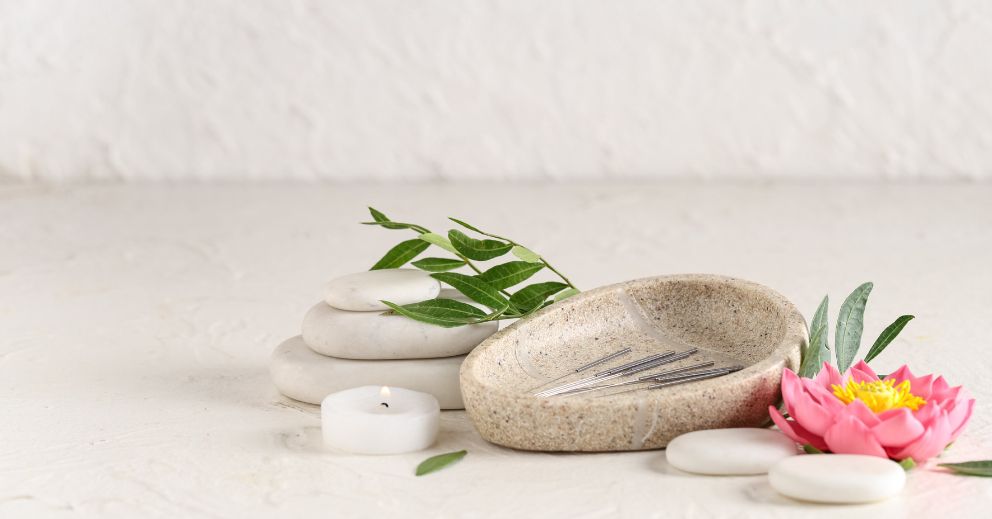
Acupuncture involves inserting very fine, sterile needles into specific points along the body’s meridians. The goal is to unblock stagnant qi and blood, encouraging the body’s own systems to restore balance and ease pain.
From a modern research perspective, acupuncture is also understood to stimulate nerves, muscles, and connective tissue. This can trigger the release of natural pain-relieving chemicals and improve blood flow to the treated area.
Common Types of Pain People Seek Acupuncture For
- Lower back pain and sciatica-type discomfort
- Neck and shoulder tension
- Tension headaches and migraines
- Knee and joint pain
- Sports injuries and muscle strains
- Period pain and pelvic discomfort
What a Typical Session Involves
Most people are surprised by how gentle the process actually is. A practitioner will usually ask about your pain history, lifestyle, sleep, and stress levels before choosing which points to treat.
Needles are left in place for around 20 to 30 minutes while you lie comfortably. Many people describe the sensation as a dull ache, tingling, or heaviness rather than sharp pain.
Why Acupuncture Can Help When Other Treatments Haven’t
Chronic pain is complicated. It often involves not just the injured tissue, but also nervous system sensitivity, stress, poor sleep, and muscular compensation patterns that build up over time.
Acupuncture doesn’t just target the “sore spot.” It looks at the broader pattern behind the pain, which is often why people who’ve tried medication or a single type of therapy without lasting relief find a more holistic approach helpful.
The Nervous System Connection
Persistent pain can keep the nervous system in a heightened, sensitive state, sometimes long after the original injury has healed. Acupuncture is thought to help calm this overactive response, which can reduce how intensely pain is felt.
Supporting the Body’s Natural Recovery
By improving local circulation and reducing muscular tension, acupuncture can create better conditions for the body to repair itself. It’s often used alongside other treatments like physiotherapy, remedial massage, or gentle exercise rather than as a stand-alone fix.
What to Expect Before Trying Acupuncture for Pain
If you’re considering acupuncture for the first time, it helps to know what a realistic outcome looks like. Most practitioners will be upfront that results vary depending on how long you’ve had the pain and what’s causing it.
Signs Acupuncture Might Be Worth Exploring
- Pain that flares with stress or fatigue
- Tightness that hasn’t responded well to stretching alone
- Chronic pain with no clear structural cause on scans
- A preference for a drug-free, low-intervention approach
What Practitioners Usually Recommend
A short course of sessions, rather than a single visit, is typically suggested to properly assess how your body responds. Your practitioner should also ask about medications and health conditions to make sure treatment is appropriate for you.
Thinking About Trying Acupuncture for Your Pain?
Understanding why your pain behaves the way it does is often the first step toward actually managing it.
At Village Remedies, acupuncture is approached as part of a broader picture of your health, not a quick fix for a single sore spot. If you’d like to talk through your symptoms and see whether acupuncture could help, getting in touch is a simple next step.
Key Takeaways
- Chinese medicine views pain as a sign of blocked or imbalanced qi and blood flow, not just physical damage
- Concepts like blood stagnation, cold, and damp help explain different pain patterns and behaviours
- Acupuncture aims to restore flow, calm the nervous system, and support the body’s natural healing response
- It’s commonly used for back pain, headaches, joint pain, and stress-related tension
- A short course of sessions, rather than one visit, gives a clearer picture of how you’ll respond
- Acupuncture often works well alongside other treatments rather than replacing them entirely
FAQ
How many acupuncture sessions does it usually take before pain improves?
This varies a lot depending on how long the pain has been present and what’s driving it. Some people notice a difference after two or three sessions, while more chronic or long-standing pain may need a longer course to see meaningful change.
Does acupuncture hurt more than a regular injection or blood test?
No, the needles used are much finer than those used for injections or blood draws. Most people feel a light prick, followed by a dull, heavy, or tingling sensation rather than sharp pain.
Can acupuncture be combined with physiotherapy or medication for pain?
Yes, acupuncture is often used alongside other treatments rather than as a replacement for them. It’s worth mentioning any medications or existing treatment plans to your practitioner so everything works together safely.
Is acupuncture only useful for muscular or joint pain, or does it help other types too?
While it’s widely used for back, neck, and joint pain, many people also seek it out for headaches, period pain, and stress-related tension that shows up physically. The underlying goal is always the same: restoring flow and easing whatever’s blocking it.
What should I do if my pain doesn’t improve after a few sessions?
A good practitioner will reassess your treatment plan if progress stalls, rather than continuing the same approach indefinitely. This might mean adjusting the points used, the frequency of sessions, or recommending you see another healthcare provider alongside acupuncture.